
The Human Tailbone - An Evolutionary Tale

Updated: Jan 12

Introduction
Is our coccyx, the set of several small bones at the end of our vertebral column, best explained by evolution or can it be accommodated rationally by other competing explanations? An objective look at this vestigial structure indicates evolution is by far the only rational explanation. To begin, we need to be clear how a vestigial structure is properly defined in science.
Vestigial Biological Structures.
In biology the definition of a vestigial structure is one without function, diminished function, or one that has lost its original function. Unfortunately, in common use and even present in some biology texts it is defined only as a loss of function. A look at better sources and older sources shows that only without function is not a proper definition. 1. "Vestigial structures are those that appear in a rudimentary form in some organisms but in a fully developed, functional form in other, closely related animals; or they are poorly developed structures thought to have been fully functional in ancestors of the modern form" (pg. 777)
~ Biology by Leland Johnson 1983
2. [Vestigial] - "refers to an organ or part which is greatly reduced from the original ancestral form and is no longer functional or is of reduced or altered function". ~ www.biologyonline.com
3. "Vestigial - a degenerate or imperfectly developed organ or structure that has little or no utility, but in an earlier stage of the individual or in preceding evolutionary forms of the organism performed a useful function" ~ www.dictionary.com
4. "Vestigial - (of certain organs or parts of organs) having attained a simple structure and reduced size and function during the evolution of the species: the vestigial pelvic girdle of a snake" ~ Collins English Dictionary, 2014.
5. "Vestige - a small, imperfectly developed, or degenerate structure which represents an organ or structure which was fully developed and functional in an ancestor or in an earlier state of development." ~ Dictionary of Biology, Edwin Steen. 1971
What about dictionaries?
Dictionaries report usage but don’t decide proper or best definitions. For example, a person producing dictionaries (lexicographer) once wrote appropriately:
“The writer of a dictionary is a historian, not a lawgiver. . . To regard the dictionary as an 'authority,' therefore, is to credit the dictionary writer with gifts of prophecy which neither he nor anyone else possesses.”
So dictionaries can’t help us to decide the best or proper definition. The photograph in Figure 1 below shows used wine bottles that have been repurposed into new and different artistic functions but certainly not what they were originally intended for.(1)

Figure 1. These wine bottles have a function/use but not their original one. They would fit the definition of vestigial. (1)
The Human Coccyx
The human tailbone consists of 3 - 5 small fused bones. One can see this plainly. It also is obvious that these look like small fused vertebrae. As mentioned above, the coccyx fits the definition of vestigial from an ancestral tail our species had, and a coccyx also exists in the other great apes who are missing tails but have small shrunken-appearing bones that fuse to form their coccyx. We would expect that a long tail that shrunk dramatically through evolution would still have muscles and nerves attached and indeed it does, so arguing that some functions have been identified in no way dismisses it as being vestigial. See the diagram in Figure 2 and notice how small and vestigial the human coccyx is. See also the X-ray in Figure 3. Notice the significant curve that can vary between individuals. A fall can break the angle and some women can suffer a painful break during childbirth (3). This is absolutely better explained as an evolutionary product. If it was specially created, why make it look like a vestigial fusion of shrunken vertebra? It’s such a small collection of bones, why do we not find it as a single bone or two together if created rather than the product of evolution with 3 - 5 small vestigial fused vertebrae?
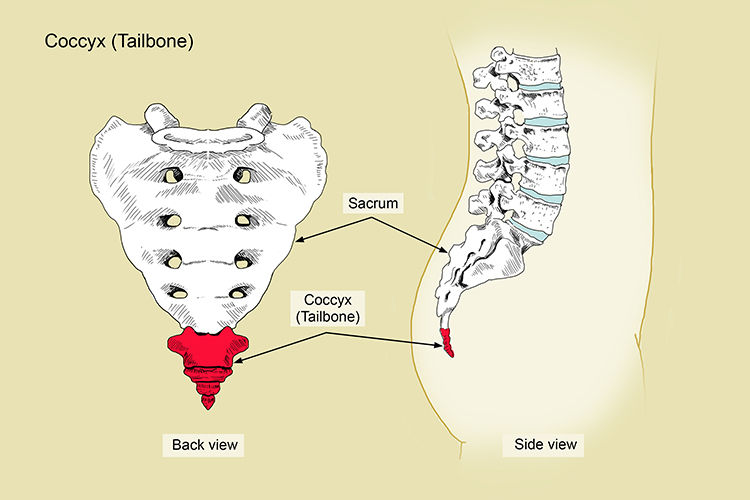
Figure 2. Drawing to scale of how small the human coccyx is. (2)

Figure 3. Close up sagittal radiograph of normal human coccyx. S= Sacral vertebra. Cy = Coccygeal vestigial vertebra. (3)
Testing the Evolutionary hypothesis for a vestigial tail origin
If the human coccyx is derived from ancestors that had tails we can make some predictions and check to see if they fit our evolutionary ancestry. Evolutionary biology is science in part because predictions can be formulated and tested with empirical observations and experiments.
First, in some instances animals show their ancestral heritage in structures that hark back to previous developmental constraints. In the human embryo a tail is present only to disappear during normal development. See Figure 4. It is best explained as an evolutionary developmental constraint.

Figure 4. Human vestigial tail present during embryogenesis. It is absorbed and disappears later. (4)
Second, if the DNA responsible for making tails is still present but degraded and turned off, it’s not uncommon to have these rarely become active. These are called atavisms. An atavism is the reappearance of traits from distant ancestors that occur due to the reactivation of dormant genes. There are cases known where people grow true tails with vertebrae present instead of a coccyx. Unlike pseudo-tails, these have real bone and muscles. See Figure 5. Whales rarely grow hind limbs, as do snakes because their ancestors had legs. See Figure 6. The DNA instructions are still there and under rare conditions can be partially activated. If enough of it is not too severely degraded, an atavism will form. Besides atavistic tails, for example humans commonly have accessory nipples called supernumerary nipples that often occur along a nipple line. These supernumerary nipples are common and often misdiagnosed as moles.

Figure 5. True atavistic human tail with developed coccygeal vertebrae, muscles and nerves. (5)

Figure 6. Snake with an atavistic leg. The person attacking it, Dean Qiongxiu, of China severed its head in her bedroom. (6)
Third, we should look to see if geneticists studying the human genome have found any evidence of changes causing the loss of tails in us and the other great apes. It would not be logical for humans to have broken DNA to make tails if they never had tails in ancestors to begin with. In 2024 a paper by Xia et al. demonstrated what happened in the history of hominid ancestors to cause the loss of our tail. (7). There are millions of DNA elements that have jumped around in our past genome. One of these transposon categories are called Alus. As explained by Eissenberg (8), researchers have found how the loss of tails occurred in humans and other apes without tails.
A gene, TBXT, is present in tailless apes and tail bearing simians. In the middle of this gene is an Alu that jumped into the gene in the past. A second Alu close to the first is located in tailless apes, and the researchers hypothesized that the two Alus looped onto one another hiding the TBXT from being transcribed. This is similar to the production of solo LTRs as noted in the blog on why shared random ERV insertions are some of the greatest evidence for human evolution. See HERE. The researchers tested their hypothesis by genetically engineering mice with TBXT genes flanked by Alus producing abnormal gene products. "Detailed analysis of gene expression suggested that the ratio of normal to abnormal gene products was important to tail truncation. Further crosses generated mice with a combination of gene products that resulted in tailless mice". (7)
Conclusion
The human coccyx is a great example of a vestigial structure. Functions, if present, are not applicable given the proper definition of vestigial in biology. It appears to be fused vestigial tail vertebrae. Human embryos have tails that later disappear. Humans are rarely born with true atavistic tails indicating that the DNA for making a tail is still present. Scientists have identified a gene, TXBT, that if compromised by Alu transposon genes as in humans can produce aberrant gene products that go on to produce a tailless state in genetically engineered mice. It is not rational to continue to deny that the human tail is a vestigial remnant inherited from our ancestral fossil hominids. The response of anti-evolutionists that since the coccyx has functions it can't be vestigial is not tenable (9,10,11).
References
1.From pixabay: Non-copyright photo 2.From: Fair use intention. For educational purposes only https://mammothmemory.net/biology/skeletons-and-bones/skeleton-and-bones/coccyx.html
3.From: Imaging Coccygeal Trauma and Coccydynia. July, 2020. Skalski et al. Fair use intention. For educational purposes only
https://pubs.rsna.org/doi/10.1148/rg.2020190132 4. From: Fair use intention. For educational purposes only https://www.talkorigins.org/faqs/comdesc/section2.html#vestiges
5.From: Fair use intention. For educational purposes only https://www.talkorigins.org/faqs/comdesc/section2.html#vestiges
7.https://pmc.ncbi.nlm.nih.gov/articles/PMC10901737/pdf/41586_2024_Article_7095.pdf 8. How humans lost their tales. 2024. https://pandasthumb.org/archives/2024/04/how-humans-lost-tails.html
9https://www.gotquestions.org/vestigial-organs.html 10.https://answersingenesis.org/human-body/vestigial-organs/setting-the-record-straight-on-vestigial-organs/?srsltid=AfmBOoo70AygdBzAa1WQ8HFceRofJKpS3_-c8eXcIwZRlgAooLJIiiz3



Comments